
Seeing Is Retrieving
Notes on active noticing

(Originally posted Aug. 29, 2023. Amazingly, nothing in what’s below has changed.)
In the 30-plus years I’ve spent a portion of each summer on Lower Saranac Lake in upstate New York, I’ve paddled a body of water called Fish Creek at least three hundred times. Each time I’m at least mildly amazed by what I experience following its snakelike trail of dark water, flanked on both sides by yellow and white lily pad flowers, purple pickerelweed and orange snapdragons, backdropped by a deep Adirondack forest on one side and more sky than I ever see everywhere else.
Fish Creek’s menagerie is spectacular, and features great blue herons, bald eagles, ducks, frogs, turtles, kingfishers, aquatic mammals from beavers to minks to otters and more, dragonflies, damselflies, of late cormorants—sadly methinks a sign of climate change—and the only unwelcome feathered creature, geese. I want to like geese, but they offer nothing but endless poop and crankiness. But what’s most amazing is not what I experience, but rather that each experience is, to a surprisingly significant degree, different from all the others.
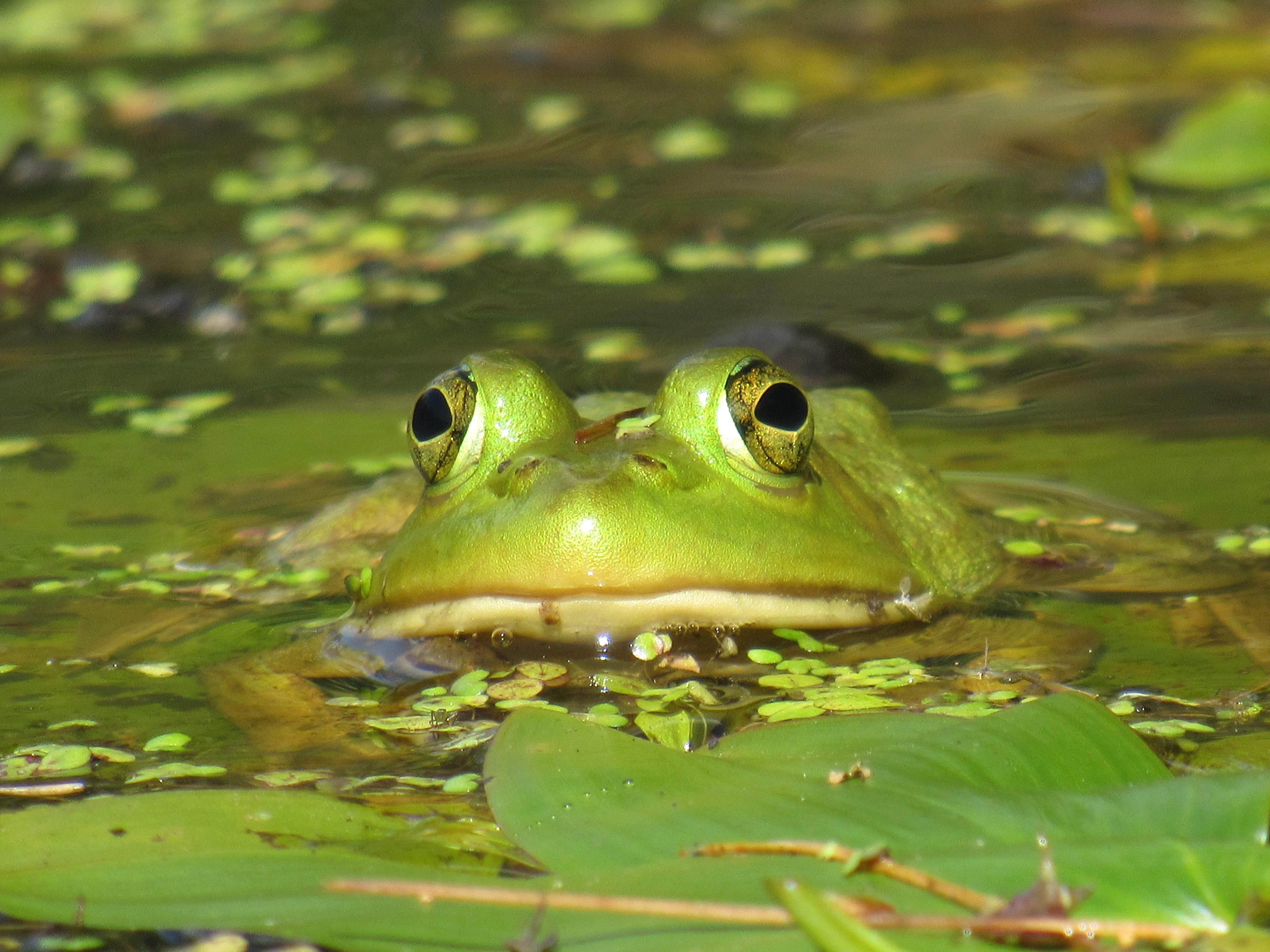
I owe Fish Creek a deep debt of gratitude, not only for the many joyful hours spent paddling its endless wonders, but for its gift of heightened awareness. There is so much to see back there, but its dazzlements fully reveal themselves only to those who both have and are willing to take the time to slowly scour its land and seascape. I’m at a fortunate point in my life where I’m rarely if ever in a hurry, so I capture almost all of it. For example, if there were a professional Who Can Spot The Heron From Farthest Away tour, I would be its Tiger Woods. I also excel at Noticing Frogs Who Not Only Blend In Really Well With Their Surroundings But Are Submerged Up To Their Eyeballs, and as proof I offer this:
We live in ruts filled with snowflakes; constantly changing elements within our daily routines that plant each iteration firmly somewhere on the continuum of uniqueness. For me, the natural world brings this reality into its sharpest focus. I don’t know when it was, but one day, after hours across years watching great blue herons hunt, I noticed that when they strike and miss, they shake the excess water off their beaks. I like to think it’s their way of saying “I meant to do that,” but more likely it’s the heron equivalent of me squeegeeing excess water off my body in my post-shower/pre-toweling off routine, something I only recently learned I co-opted from a friend my freshman year in college. Yes, herons spend a ton of time in the water, but that doesn’t mean they like getting any wetter than they have to.
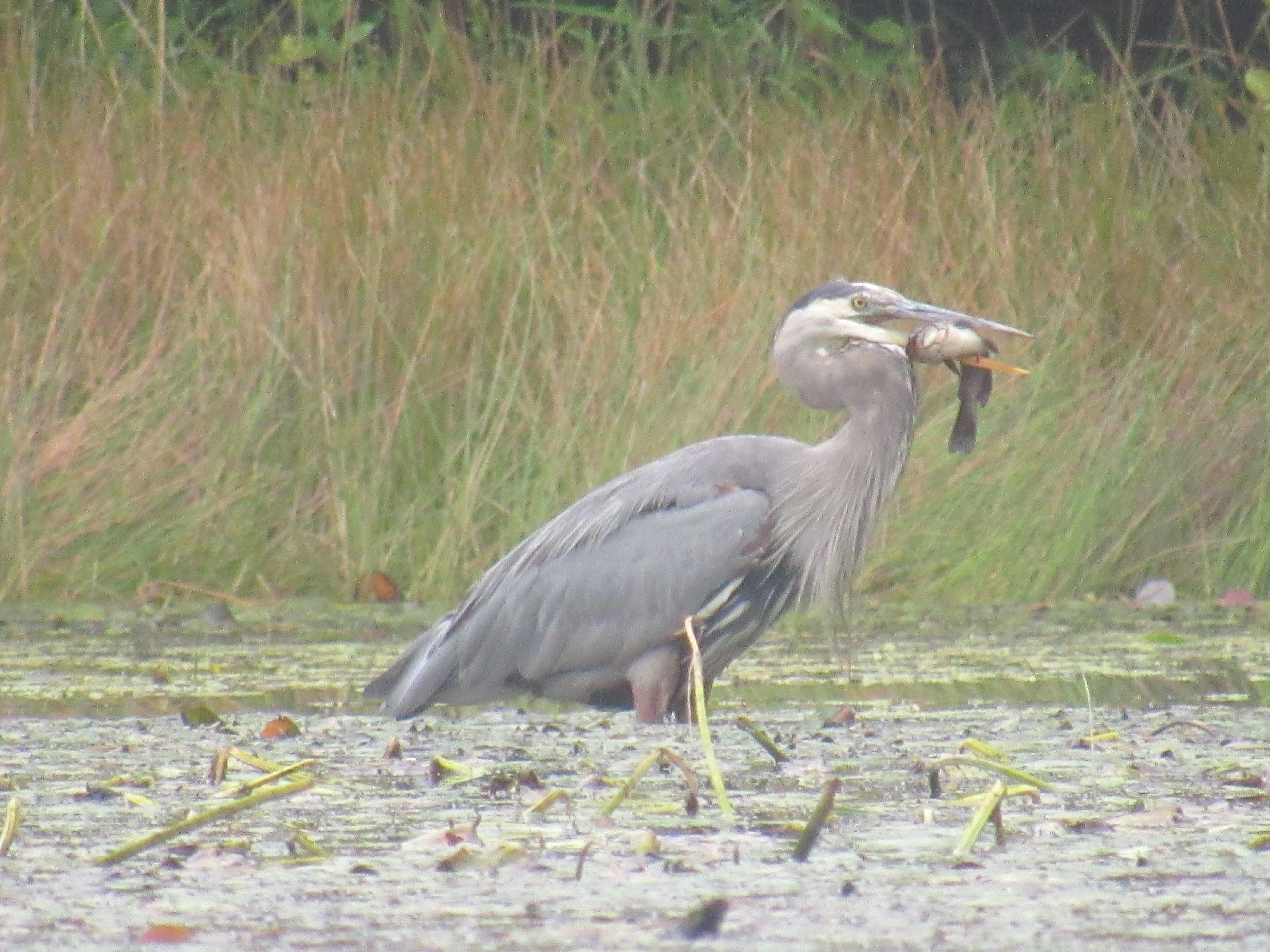
Other things about great blue herons that took me longer than they should have to notice: 1) Their knees bend the opposite way of ours, allowing them greater pedestrian access to their reedy hunting grounds and, as a bonus, making them wonderfully reminiscent of John Cleese in Monty Python’s classic Ministry of Silly Walks; 2) Their beaks are uniquely well-suited to catching fish, and uniquely ill-suited to swallowing fish. They often emerge from a strike with their prey wiggling perpendicular to their long, narrow beaks (see below), and must somehow—without thumbs, mind you—maneuver their meal 90 degrees without dropping it, which they often do, which disappoints them and me but presumably not the fish.
But you don’t have to be in a watery wonderland to find golden needles in mundane haystacks. I’ll admit to not much more than a passing acquaintance with the new millennium workplace, and while my sense is its inherent monotony has not, of late, been significantly altered, finding inspiration in its variation has throughout human history made the enterprise more satisfying. In the three years I was sports editor at the Owatonna People’s Press, I had a hand in the production of about 1,000 morning editions, and yes, no two were alike. Each had core elements its readership demanded; you could write stories about the most horrifying happenings a small town could endure and hear crickets, but forget the daily crossword or Jumble and the phones would ring like a coked-up kettlebell choir. Six days a week—Owatonna was a church-going community, so no toiling on the Lord’s day meant no Monday paper—we filled a different news hole with different news, and while the daily process was identical, the products were fraternal at best. And if I’d been paying closer attention, one Wednesday’s paper would not have listed the lunch entrée at Owatonna High School as “oven fried children.”
Speaking of sports, practiced repetition is its essence, and elite athletes spend countless hours working toward optimal responses to every conceivable scenario, trying their best to leave all variables on the practice court. I’m nothing like them, which is perhaps why each of the approximately 10,000 times I’ve stepped off a tennis court I leave with something I didn’t have when I arrived. Most often it’s about the game itself, which is so much more wonderfully complex than it appears. Each of its essential elements—footwork, concentration, weight transfer, swing and more—is in turn its own onion, with near-endless layers to explore and minutiae to mine. But you have to be careful, as what can start out as a keen observation that leads to an uptick in understanding, if over-investigated, can quickly turn on itself and breed confusion and inexplicably shitty play.
I’m currently reading Richard Russo’s Somebody’s Fool, the third in a trilogy of finely observed novels about wonderfully flawed characters in a decaying town in upstate New York. I am a relatively unsophisticated consumer of great literature, and so I steer clear of offering any substantive analysis of Russo’s overarching themes, other than his deep well of kindness for his characters. What keeps me coming back to his work, despite my status as one of the least well-read people I know, is his gift for observation, the light he shines on those tiny acts from meanness to mercy that collectively illuminate what it is to be human.
This is not a treatise on stopping and smelling the roses, though that’s not a bad way to amble through life. For me it’s more about trying to be open to seeing those things that pass through my life with regularity in potentially new and more proximate ways. It’s also trying, and mostly failing because I find it quite difficult, to understand how what I’m thinking and feeling as I meander my familiar paths affects what I see and how I see it. And not only because I’m wandering within horseshoes and hand grenades distance of existential here, let’s return to our overall theme with a look at the master of miniscule observation: Jerry Seinfeld, specifically his eponymous sitcom. The show that claimed to be about nothing was anything but, and in large part was a user’s guide to paying attention to smaller but rarely less important building blocks of living in a world that, for good or ill, has other people in it. Never-before identified human archetypes like close talkers, low talkers, regifters, and mimbos were given form and storylines, while phenomena like shrinkage, shiksappeal, and Festivus’ airing of grievances resonated for millions who had experienced them previously but namelessly. The show’s characters hoisted themselves on the often small but significant petards of daily life, acts of self-sabotage that gave me and likely millions of others lessons in how to notice and assess the meaning of our versions of their minutiae.
This got a bit more meta—a word now making its debut under my byline—than I intended, but that’s okay, as it fits with the overall theme of finding the unexpected within the familiar. If for some reason you’re interested in doing so, my best advice is to pretend you’re a photographer for a day, or even for a medium-to-long walk. Whenever I take my camera with me, I see things I wouldn’t otherwise, and not only when I peer through its lens. It’s a tool for noticing the tiny which, sometimes, brings the big picture into focus.
Jonathan, I LOVED this text and its appeal! Funny with a message. Thank you and enjoy the rest of your summer!