
Thanks, Teach!

Not so long ago I got a call from an extremely earnest young woman representing my alma mater who, shockingly, was asking for stories instead of money. Apparently Kenyon College is celebrating its 200th birthday this year, and they’re doing an oral history project because, well, why not? Since I have contributed exactly nothing of any value to the place since I graduated in 1978, this seemed an easy way to give a little something to the institution where, to be honest, I learned how to learn.
I hit Kenyon after 13 years in the DC public school system, the first seven of which were as terrific as the final six were abysmal. I walked the half mile to Shepherd Elementary School every weekday morning—coming home for lunch, mind you—through my wooded, upper middle class, well-integrated neighborhood, and was greeted there by uniformly excellent teachers. Apparently I was quite unhappy the first day of kindergarten, and my cousin Ellen happened to be a grade up and right next door, so my teacher, Mrs. Cullen, walked me over to the legendary Mrs. Kagan’s classroom, and I spent the morning easing into this major life change next to my beloved cousin in the ultra-cool environs of first grade. Second grade was spent in the softly nurtured nest that was Mrs. Florence’s classroom, and in third grade Mrs. Isaacson showed me how much fun math could be. Fourth grade was notable for the creativity of Mrs. Koiner, whose special events included a luau and a milk-tasting party, at which we all learned the valuable life lesson that buttermilk is not for drinking. In fifth I learned that men also could be teachers, via the young, Mod Squad-esque duo of Mr. Geraghty and Mr. Gordon. And in sixth grade the tiny terror that was Mrs. Manchester made the smart-ass boy band—of which I was a leader—straighten up and fly mostly right.
For seventh grade, starting in the fall of 1968, and for reasons that are another essay entirely, I crossed Rock Creek Park to attend Alice Deal Junior High. For the first week I took three city buses and 90 minutes to make what was a 15-minute car trip, so from then until I got my license I secretly hitchhiked to school. All I really remember about junior high is it was so bad I’ve blocked most of it out of my memory. The only teachers I remember were two in the French department: one because I had a huge crush on her, and the other because she gave me my first F, which as I recall was richly deserved.
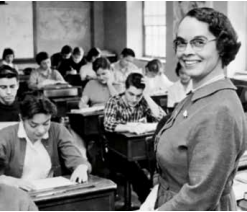
High school, then named for Woodrow Wilson, was better, as I’d hit my growth spurt at 15 and was less of a target, and most of the bullies who targeted me and the other teenage shrimps had turned 16 and dropped out. Still, almost all of the teachers I had were either ill-equipped, ill-tempered or both, with two critical exceptions. Edna B. Jackson, who in 1954 became the first black teacher at the school that now bears her name, was a 4’9” force of nature, and I loved her as much as I’ve ever loved anyone who scared the shit out of me. She was innovative, challenging, and tireless, even though she’d been teaching for almost 40 years by the time we met. Mrs. Jackson and I shared space in a school that was overcrowded, mostly with students who came from across the city and were relatively and understandably pissed off to be there. I took a class from her each of my three years at Wilson, and somehow she managed to not only keep my interest but start me on the road to becoming a critical thinker and reasonably engaged Planet Earth citizen. Joseph P. Morgan, lover of literature, tortoise-shell glasses and three-piece pin-striped suits, and as such utterly out of place at Wilson, was my other academic savior, an English teacher of uncommon patience who never misspoke and who somehow managed, with assists from the likes of John Steinbeck and J.D. Salinger, to convince me that reading didn’t have to be a chore.
Despite Mrs. Jackson’s and Mr. Morgan’s best efforts, I was woefully unprepared when I landed at Kenyon in the fall of 1974. I vividly recall sitting in a study carrel and reading the first paragraph of Francis Bacon’s Novum Organum—my first assignment—seven times, with no discernible uptick in comprehension at any point along the way. My panic must have carried over to my first exam, which came in a survey course on Western civilization, and is at the center of the story I told to the earnest young woman who called me way back at the beginning of this piece.
The blue book was returned to me with a C+, and I will never forget what history professor Peter Rutkoff wrote on the cover.
“This has the makings of a good answer,” he began, “which is to say you have the makings of a good student. It fails, however, in certain fundamentals ways:
1) It doesn’t answer the question.
2) It has no point of view.
3) It is incoherent.”
He certainly could have given me an F on merit, at which point I likely would have slid into an emotional tailspin and dropped or flunked out. But somewhere in the garbled mess of my answer he saw some intelligence, and the grade goosed me enough to put my head down and learn to study on the fly. As a result I got to stay at Kenyon, make some excellent friends, become a reasonably critical thinker, and learn to write, which allowed me not to have to work too terribly hard to earn a living.
I realized, after telling this story to a stranger, that I had never told Professor Rutkoff. One of the benefits of having more life behind you than ahead can be increased urgency to do what’s overdue, and this compliment/thank you was already 45 years late. It took me too long to learn this, but now I know that if you have something nice to say to someone, don’t wait, say it now. I looked him up to find that not only was he still alive but still teaching at Kenyon, so I emailed him the full story. I heard back from him within minutes, and he unsurprisingly seemed to get an enormous kick out of it. Turns out he had just retired after 50 years at Kenyon, and remembered that we are actually distant cousins, a fact he announced to the multitudes while calling roll the first day of class, at which time I was trying my best to be invisible. The bonus in his email response was finding out that his grandfather’s name is the same as my son’s.
My junior year base was London, and it was every bit the journey of self-discovery that junior years abroad are supposed to be. And I lucked out big time getting Mary Dysch, a history professor at the London School of Economics, as my academic—and everything else—adviser. I met with her at least weekly for a three-hour independent study, and more often than not either she or I hadn’t done the assigned reading, so we’d spend the hours at a pub drinking gin and tonic (her) and tepid beer (me) and discussing everything from Hitler’s rise to power to my latest romantic drama. She treated me as an adult, though I’m certain I rarely acted like one, and as her intellectual peer, which I even more certainly was not. I recently unearthed a short letter she wrote me in advance of our being in Paris at the same time, asking me to call her hotel so we could have a drink. I’m pretty sure nothing to that point in my life made me feel quite so grown up as getting a written invitation to meet my professor/advisor/friend for a drink in Paris, at least until the drink meeting actually happened.
Senior year at Kenyon was the most academically relaxed one, save completion of comps—each department’s final and most intimidating hurdle to graduation. A couple of friends and I had heard good things about Phil Church and his year-long, thrice-weekly survey course on Modern British Literature, so we signed up. The syllabus was wall-to-wall stars—James Joyce, D.H. Lawrence, Virginia Woolf, Joseph Conrad and more—but the jewel in the crown was Church himself. We did a different book and author each week, and as good little acolytes we came to his introductory lecture each Monday morning having read the novel or poetry in question. And each Monday afternoon we would gather and re-read the work in its entirety, as we had apparently missed, well, everything. We had to stifle the impulse to burst into applause at the end of his lectures, they were that brilliant and emotionally stirring. We often said, with the hyperbole of youth, that if we could just get out of a novel what Phil Church could, we would need nothing else in life. What we seemed not to know, at least at the time, was the painful flip side of being able to walk miles in every character’s shoes, which explained his frequent post-class trips to the store for a 12-pack.
School days end, and learning becomes less formal but no less important. Over the years my teachers have included my wife, my kids, my kids’ teachers, my friends, my kids’ friends, songwriters, podcasters, random strangers, and too many other human and animal categories to count. But the ones who sign up for these overworked-and-underpaid-but-hugely-important long hauls in classrooms, who taught us how to focus and harness our natural curiosity during periods when biology roiled our innards, they are the ones to whom we owe among the biggest thanks. It’s remarkable what an impact someone can have on your life even though, often, you never even knew their first name.